An artist's concept of a highly magnetized neutron star. According to current theory, axions would be created in the hot interior of the neutron star. UC Berkeley astrophysicists say that the strong magnetic field of the star will transform these axions into gamma rays that can be detected from Earth, pinpointing the mass of the axion. Image: Casey Reed, courtesy of Penn...
Martin White received his B.S. in 1988 from the University of Adelaide and his Ph.D. in 1992 from Yale. After postdoctoral positions at the CfPA in Berkeley and an Enrico Fermi Fellowship in Chicago he became Assistant Professor of Physics and of Astronomy at UIUC. In 1998 he became an Assistant Professor of Astronomy at Harvard before moving to Berkeley as a Professor of Physics in 2001.
Research Interests
I am a theorist and phenomenologist. While I originally trained in Particle Physics, in the last few years my interest has centered around the question of the formation of...
Chris McKee received his Ph.D. in Physics from UC Berkeley in 1970. After a brief stay at Lawrence Livermore National Laboratory, he spent a year as a postdoc at Caltech. He then went to Harvard as an assistant professor of astronomy for three years, and in 1974 he joined the Physics and Astronomy Departments here at Berkeley. He served as the first Director of the Theoretical Astrophysics Center in 1985, and from 1985-1998 he directed the Space Sciences Laboratory. He was the Henry Norris Russell Lecturer of the American Astronomical Society in 2016 and appointed a Legacy...
Prof. Kasen received his B.S. from Stanford University and his M.S. and Ph.D. in physics from UC Berkeley. Prior to returning to Cal, he was the Alan C. Davis fellow at Johns Hopkins University and a Hubble fellow at UC Santa Cruz. He joined the Berkeley physics faculty in 2010, jointly appointed with the nuclear science division at LBNL.
Last October, following one of the brightest flashes of gamma rays ever observed in the sky, telescopes around the world captured a wealth of data from an event that is thought to herald the collapse of a massive star and the birth of a black hole.
But that fire hose of data demonstrated clearly that...
Professor Emeritus and Professor of the Graduate School
Wick Haxton received his B.A. from UC Santa Cruz in 1971 and his Ph.D. from Stanford in 1976. He spent most of his early research career in the Los Alamos Theory Division, where he was a J. Robert Oppenheimer Fellow and later a staff member. He moved to the University of Washington in 1984 as Professor and, for 15 years, Director of the Department of Energy’s Institute for Nuclear Theory. In 2009 he joined UC Berkeley as Professor of Physics and Lawrence Berkeley Laboratory as Senior Faculty Scientist. His research interests include neutrino physics, nuclear astrophysics, tests of...
Uros Seljak joined Berkeley as a faculty in 2008, jointly appointed with LBNL. He received his B.S. in 1989 and M.S. in 1991 from Ljubljana University, Slovenia and his PhD in 1995 from MIT. He was a Smithsonian Fellow at Harvard-Smithsonian Center for Astrophysics from 1995 to 1998. Subsequently he served as a faculty at Princeton University, ICTP Trieste and Zurich University. He is the recipient of the David and Lucile Packard Fellowship in Science and Engineering (2000), the Alfred P. Sloan Fellowship (2001), the Helen B. Warner award of American Astronomical Society (2001) and the NSF...
The purple and white emissions at the top are referred to as "Steve," while the green emissions are called "picket fence." The rare phenomena, which are distinct from the typical aurora, often occur together and may be caused by similar conditions at the edge of space. The photo was taken looking south over Berg Lake toward Mt. Robson in the Canadian...
Jonathan Arons earned his Ph.D. in Astronomy from Harvard in 1970. He was a postdoctoral fellow at the Princeton University Observatory in 1970-71, and at the Institute for Advanced Study in 1971-72. He joined the Astronomy Department at UC Berkeley in 1972, and the Physics Department in 1980. Fellowships and honors include: Woodrow Wilson and Danforth Graduate Fellowships, 1965-70; Guggenheim Fellowship, 1980; Miller Professorships, 1985-86 and 2002-03; elected as an APS Fellow in 1984. He currently serves as Executive Director of the Miller Institute and as Director of the Theoretical...
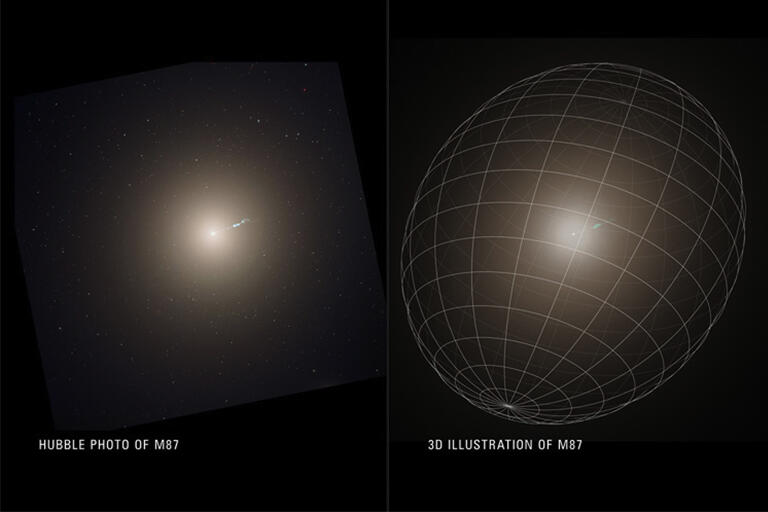
Seen from Earth, the giant elliptical galaxy M87 is just a two-dimensional blob, though one that appears perfectly symmetrical and thus a favored target of amateur astronomers. Yet, a new, highly detailed analysis of the motion of stars around its central supermassive black hole — the first black hole to be imaged by the Event Horizon Telescope...