Eric Y. Ma received his B.S. in Physics from Peking University in 2010 and his Ph.D. in Applied Physics from Stanford University in 2016. He stayed at Stanford as a joint postdoctoral scholar in Applied Physics and Electrical Engineering. He was also briefly Senior Scientist at Apple. In July 2021 Dr. Ma joined UC Berkeley full-time as Assistant Professor in Physics and by courtesy EECS, and currently holds the Georgia Lee Chair in Physics.
Research Interests
Most practical phenomena, except those related to nuclear reactions, can be well described by atomic nuclei and electrons...
Alessandra Lanzara received her PhD in physics from Universita’ di Roma La Sapienza, Italy in 1999. She was a postdoc at Stanford University for three years since 1999. In 2002 she joined the physics Department faculty at UC Berkeley as Assistant Professor and since 2011 she is a Full Professor. She is also a Senior Faculty Scientist at the Materials Sciences Division of the Lawrence Berkeley National Laboratory since 2002.
She is recipient of many prizes among which was elected Fellow of the American Physical Society in 2008 and elected to the American Academy of Art and Science in...
Matt Pyle received B.S. in Physics (2001) and B.E. in Aerospace Engineering (2002) from the University of Notre Dame, and a Ph.D. in Physics from Stanford University (2012). Subsequently, he crossed the bay and was a postdoctoral researcher at Berkeley. He joined the Berkeley Physics faculty as the Garland Assistant Professor in 2015.
Research Interests
Many of the questions that we would like to ask about the nature of the universe today, for example "could dark matter be composed of particles with mass less than that of a proton?", are simply impossible to answer with present...
Dr. Leone received his B.A. in Chemistry at Northwestern University in 1970 and his Ph.D. in Chemistry at the University of California at Berkeley with Professor C. Bradley Moore in 1974. He was an assistant professor at the University of Southern California from 1974-76. He assumed a position with NIST and the University of Colorado in 1976 and became a full professor in 1982. Dr. Leone was a Fellow and staff member of the National Institute of Standards and Technology, a Fellow of JILA, as well as an Adjoint Professor of Chemistry and Biochemistry and a Lecturer of Physics at the...
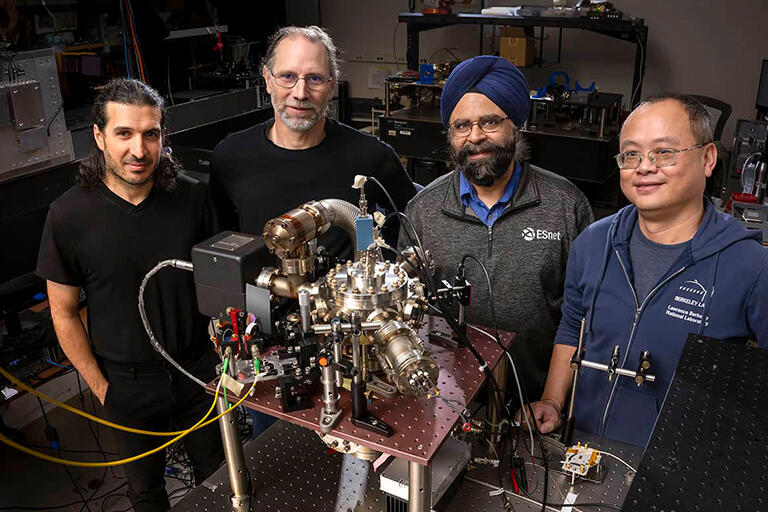
QUANT-NET researchers Erhan Saglamyurek, Hartmut Häffner, Inder Monga and Wenji Wu demonstrate their ion-trap quantum processor, a key subsystem in the network testbed connecting Häffner’s UC Berkeley physics lab to Berkeley Lab.
Today’s internet distributes classical bits and bytes of information over global, even interstellar, distances. The quantum internet of tomorrow, on the other hand...
Irfan Siddiqi received his AB (1997) in chemistry & physics from Harvard University. He then went on to receive a PhD (2002) in applied physics from Yale University, where he stayed as a postdoctoral researcher until 2005. Irfan joined the physics department at the University of California, Berkeley in the summer of 2006. In 2006, Irfan was awarded the George E. Valley, Jr. prize by the American Physical Society for the development of the Josephson bifurcation amplifier. In 2007, he was awarded the Office of Naval Research Young Investigator Award, the Hellman Family Faculty Fund, and...
Berkeley Quantum Works (BQW) at the University of California, Berkeley has entered into a partnership agreement with IQM Quantum Computers (IQM), the global leader in building on-premise quantum computers, to usher in a new era of collaboration in quantum information science (QIS) through the development and operation of the next generation of advanced...
Image of a phonon-engineered superconducting qubit.
A team of eleven investigators at LBNL led by Assistant Professor Alp Sipahigil have been awarded $8,000,000 by DOE to develop ultrahigh frequency phononics for next generation superconducting...