
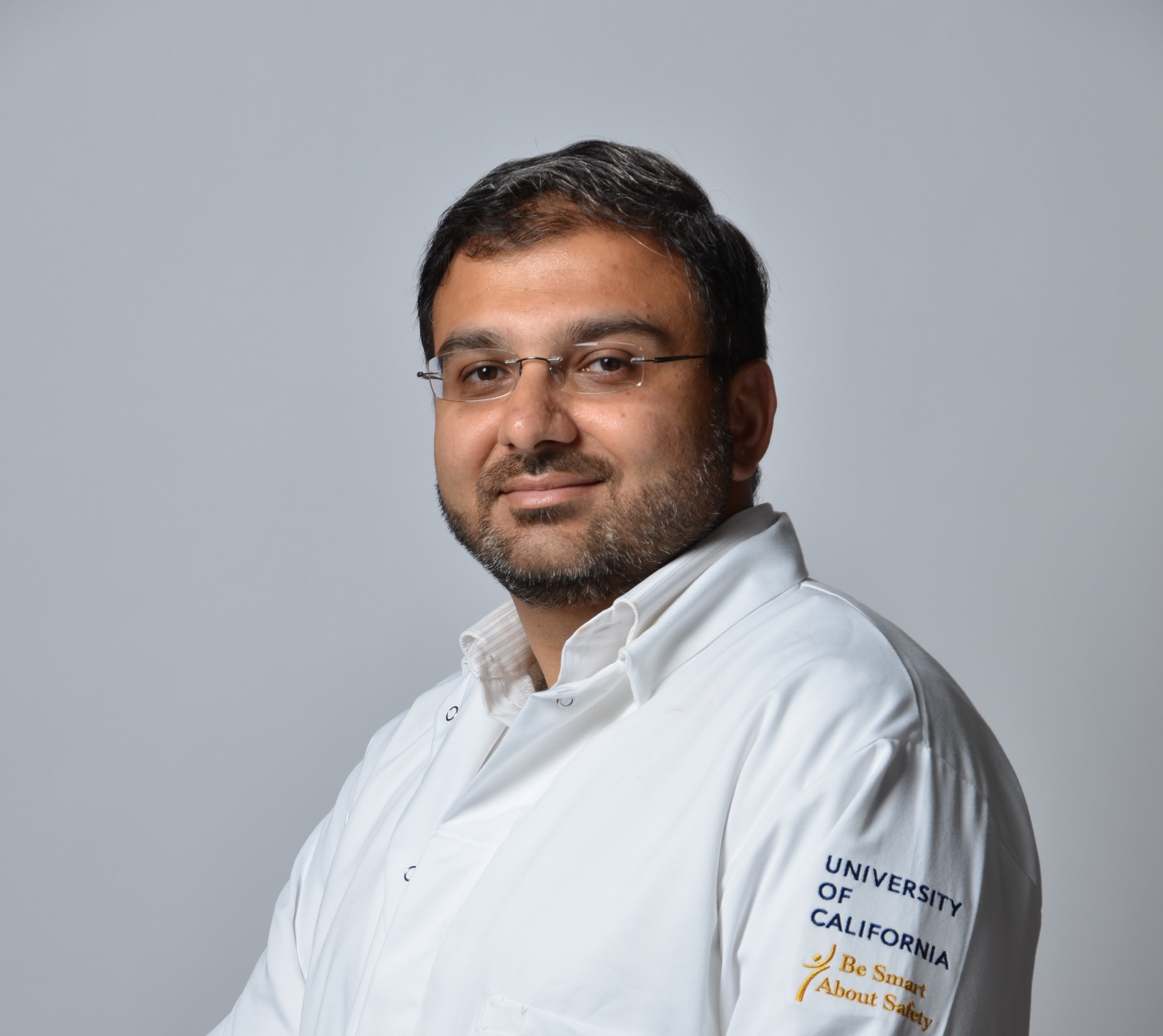
Irfan Siddiqi received his AB (1997) in chemistry & physics from Harvard University. He then went on to receive a PhD (2002) in applied physics from Yale University, where he stayed as a postdoctoral researcher until 2005. Irfan joined the faculty at the physics department at the University of California, Berkeley in the summer of 2006. He is also a professor of Electrical Engineering and Computer Science, and a Faculty Scientist at Lawrence Berkeley National Laboratory. Irfan served as Department Chair from 2023-2026.
His research group focuses on the development of advanced superconducting circuits for quantum information processing, including computation and metrology. Irfan is also the director of the Advanced Quantum Testbed at LBNL, which develops and operates full-stack quantum computing platforms based on superconducting qubits. He is known for key contributions to quantum measurement science, including real time observations of wavefunction collapse, tests of the Heisenberg uncertainty principle, quantum feedback, and the development of a range of microwave frequency, quantum noise limited amplifiers and detectors. Irfan is a fellow of the American Academy of Arts and Sciences and the American Physical Society. He is the recipient of the APS George E. Valley prize and the Joseph F. Keithley Award. He is also a recipient of the Berkeley Distinguished Teaching Award—the university’s highest award for commitment to pedagogy.
Research Interests
Current Projects
Quantum mechanics is a theory that was developed to explain the properties of atoms and light. It is one of the most thoroughly tested and successful theories in the history of science. It is also one of the most controversial ones. For over 80 years, quantum mechanics has stirred up deep debate amongst physicists, in particular about the notion that an object can be in a coherent superposition of two states simultaneously. Moreover, since the mass of an object does not directly enter into the quantum formalism, the theory should be applicable to all objects in the universe, thus raising deep philosophical questions about how then one obtains classical behavior if the word is actually quantum.
Our group, the Quantum Nanoelectronics Laboratory, investigates the quantum coherence of various condensed matter systems ranging from microscopic nanomagnets such as single molecule magnets to complex macroscopic electrical circuits. To measure the electric and magnetic properties of these quantum systems, we are developing novel microwave frequency quantum-noise-limited amplifiers based on superconducting Josephson junctions formed by both oxide tunnel barriers and carbon nanotube weak links. Current topics of research include the dependence of quantum coherence on system complexity, the non-equilibrium quantum statistical mechanics of non-linear oscillators, the quantum coherence of single molecules, and topological architectures for maximum coherence in superconducting circuits.
Publications
“Dispersive Microwave Bifurcation of a Superconducting Resonator Cavity Incorporating a Josephson junction”, E. Boaknin et al, submitted to Phys. Rev. Lett., cond-mat/0702445.
Entangled Solid-State Circuits”, I. Siddiqiand J. Clarke, Science 313, 1400 (2006).
“Dispersive Measurements of Superconducting Qubit Coherence with a Fast, Latching Readout”, I. Siddiqi et al, Phys. Rev. B 73, 054510 (2006).
“An RF-Driven Josephson Bifurcation Amplifier for Quantum Measurements” I. Siddiqi et al, Phys. Rev. Lett. 93, 207002 (2004).
“Direct Observation of Dynamical Switching between Two Driven Oscillation States of a Josephson Junction”, I. Siddiqi et al, Phys. Rev. Lett. 94, 027005 (2005).