Kater Murch is Professor of Physics and of Electrical Engineering and Computer Sciences at UC Berkeley. Kater received his B.A. in physics from Reed College in 2002. After that, he spent a long year slacking off, working as a bee keeper, honing his guitar skills, and studying the cello before finally starting his Ph.D. work at UC Berkeley with Prof. Dan Stamper-Kurn. Kater focused his interests on general problems in quantum measurement, and performed some of the first studies of position measurement quantum backaction. For a postdoc, he joined Irfan Siddiqi's group to study...
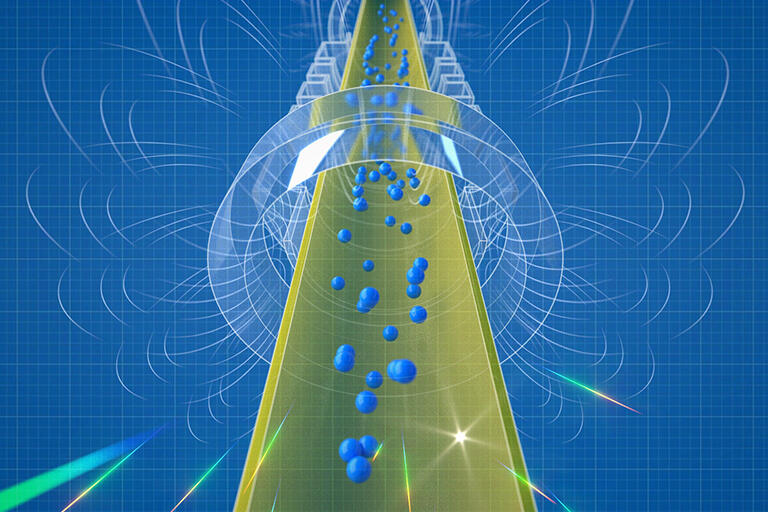
Antihydrogen atoms (blue) fall inside a magnetic trap and annihilate in an experiment to measure the effects of gravity on antimatter.
For those still holding out hope that antimatter levitates rather than falls in a gravitational field, like normal matter, the results of a new experiment are a dose of cold reality.
Dan M. Stamper-Kurn came to Berkeley following his studies at the Massachusetts Institute of Technology (Ph.D. 2000) and postdoctoral work at the California Institute of Technology (1999 – 2001). He is the recipient of the 2000 APS Division of Atomic, Optical and Molecular Physics Outstanding Thesis award, the Alfred P. Sloan Fellowship (2001 – 2003), the David and Lucile Packard Fellowship in Science and Engineering (2002 – 2007), and the Presidential Young Investigator Award in Science and Engineering (2002). He holds the Class of 1936 Second Chair in the College of Letters and Sciences...
Feng Wang received a B.A. from Fudan University, Shanghai, in 1999 and a Ph.D. from Columbia University in 2004. From 2005-2007, he has been a Miller Fellow with Miller Institute for Basic Science at Berkeley. He joined the physics faculty in fall, 2007.
Research Interests
We are interested in light-matter interaction in condensed matter physics, with an emphasis on novel physical phenomena emerging in nanoscale structures and at surfaces/interfaces. When electrons and phonons are confined in nanometer scale or at surface/interfaces, they respond differently to external stimuli. We...
Dr. Leone received his B.A. in Chemistry at Northwestern University in 1970 and his Ph.D. in Chemistry at the University of California at Berkeley with Professor C. Bradley Moore in 1974. He was an assistant professor at the University of Southern California from 1974-76. He assumed a position with NIST and the University of Colorado in 1976 and became a full professor in 1982. Dr. Leone was a Fellow and staff member of the National Institute of Standards and Technology, a Fellow of JILA, as well as an Adjoint Professor of Chemistry and Biochemistry and a Lecturer of Physics at the...
Eric Y. Ma received his B.S. in Physics from Peking University in 2010 and his Ph.D. in Applied Physics from Stanford University in 2016. He stayed at Stanford as a joint postdoctoral scholar in Applied Physics and Electrical Engineering. He was also briefly Senior Scientist at Apple. In July 2021 Dr. Ma joined UC Berkeley full-time as Assistant Professor in Physics and by courtesy EECS, and currently holds the Georgia Lee Chair in Physics.
Research Interests
Most practical phenomena, except those related to nuclear reactions, can be well described by atomic nuclei and electrons...
Hartmut Häffner received his PhD in physics from the University of Mainz / Germany in 2000. After short periods as a Postdoctoral fellow in Mainz and Bangalore/India, he received a Feodor-Lynen fellowship from the Alexander-von-Humboldt foundation Germany and went to NIST / Gaithersburg as a guest researcher (2000-2001). In 2001 he moved to the University of Innsbruck / Austria as a university assistant where he held a Marie-Curie fellowship from the European Union from 2002 - 2004. From 2004 till 2009 he worked as senior scientist at the Institute for Quantum Optics and Quantum...
Harry Levine is an experimental physicist working in quantum science with neutral atom and superconducting qubit systems. His research interests include quantum computing, quantum error correction, atomic physics, many-body physics, and quantum sensing.
Harry received his undergraduate degree from Stanford in 2015, and then received his Ph.D from Harvard in 2021 where he contributed to the development of the neutral atom platform for quantum information processing in the group of Mikhail Lukin. Harry was the 2022 recipient of the Deborah Jin Thesis Prize for his Ph.D work. He then...
Dmitry Budker received his Ph.D. in physics from UC Berkeley in 1993 and was a postdoctoral researcher at the University until his faculty appointment in 1995. Born in the former USSR, Budker was a student at the Novosibirsk State University from 1980 until 1985, when he received an equivalent to MS with honors from the Department of Physics. He then served as a junior researcher at the Institute of Nuclear Physics, where he conducted research on laser spectroscopy of atoms. In 1994, Budker received the American Physical Society Award for Outstanding Doctoral Thesis Research in Atomic,...
Roger Falcone is a professor of physics at the University of California, Berkeley, and an affiliated faculty member of Berkeley's Energy and Resources Group and Applied Science and Technology Program. He chaired the Physics Department from 1995-2000. As of January 2018 he is a Professor of the Graduate School at Berkeley. He received his A.B. in Physics (1974) from Princeton, and Ph.D. in Electrical Engineering (1979) from Stanford, and was the Marvin Chodorow Fellow in Applied Physics (1980-83) at Stanford. He was the Director of the Advanced Light Source x-ray synchrotron facility at...